
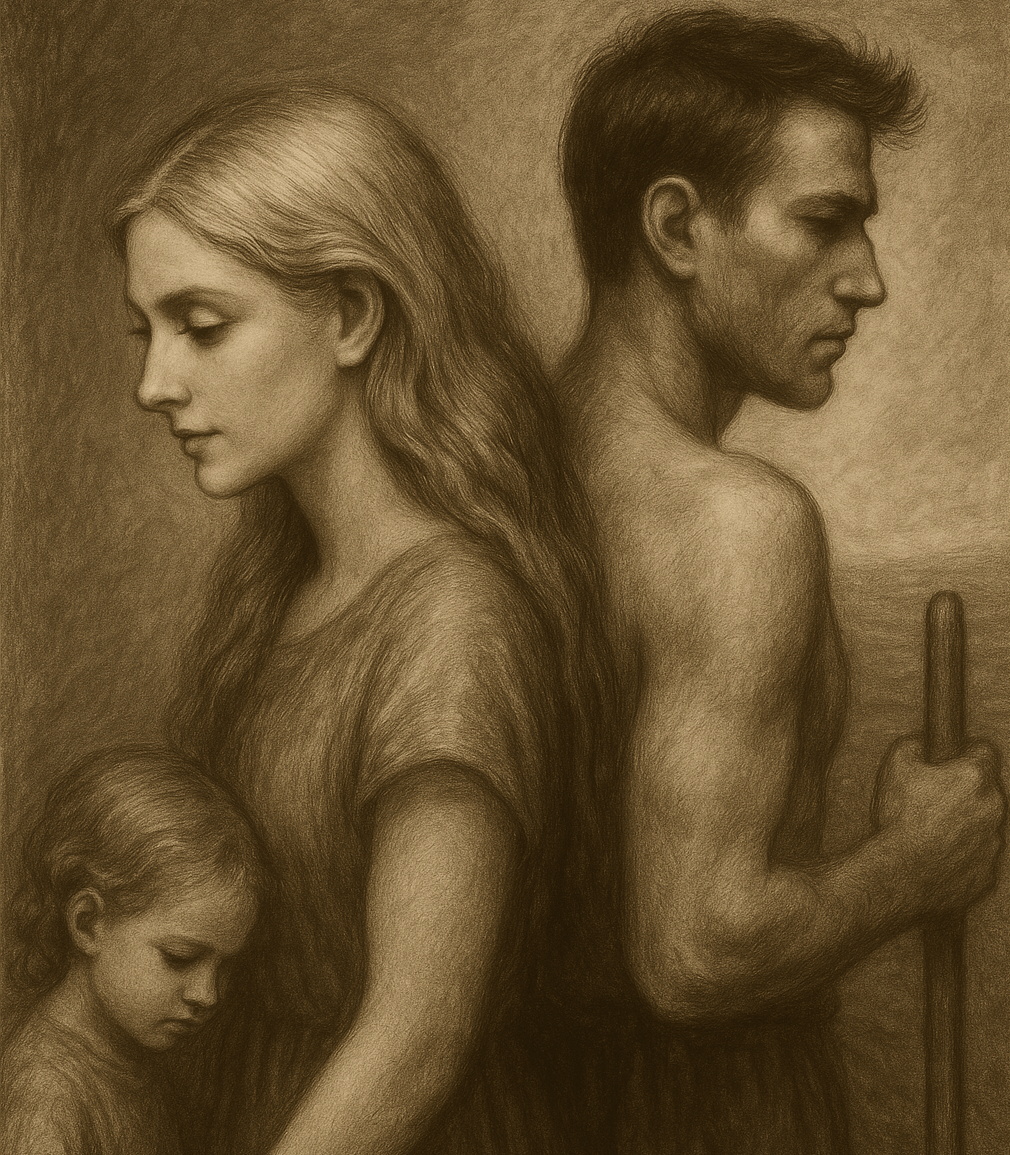
What if I told you painful childbirth was never part of God’s plan for women? For centuries, we’ve been told that Eve was cursed—and that every contraction, every scream, every tear in labor is the price women pay for her sin. But what if that’s not what the Hebrew text actually says? What if Genesis 3:16 isn’t a curse at all, but a sorrowful diagnosis of a broken world—followed by a promise of redemption?
The Myth of the Cursed Womb
“Unto the woman He said, I will greatly multiply your sorrow and your conception; in sorrow you shall bring forth children.” — Bere’shiyth (Genesis) 3:16, Cepher
Here, the Hebrew phrase “I will greatly multiply” isn’t God issuing a punishment, but expressing the natural outworking of a broken creation. In Hebrew grammar, this form often conveys what will happen as a result, not what God wills to happen. It’s descriptive rather than causative—God foreseeing and lamenting the consequence of sin, not creating new suffering.
In other words, He’s saying, “This is what sin has set in motion.” The Hebrew verb form here is imperfect—like in Genesis 4:7, where “sin is crouching at the door; it desires you, but you must rule over it”—demonstrates a descriptive, conditional function rather than a command. This grammatical mood conveys what will occur as a natural outcome rather than what God mandates, paralleling Genesis 3:16’s sense of consequence rather than causation.
It functions as a prophetic observation, much like other Hebrew verbs used to describe outcomes of human choices rather than divine imposition. The brokenness of the world now multiplies sorrow in the same way it multiplies conception and toil—the natural ripple effects of separation from His perfect design.
The Parallel with Adam — Shared Toil, Shared Grace
Notice what it doesn’t say—pain in childbirth. The Hebrew words here, ‘itstsabon and ‘etsev, don’t mean physical pain. They mean toil, hardship, emotional sorrow. The same root word is used for Adam in verse 17:
“In sorrow you shall eat of it all the days of your life.” — Bere’shiyth (Genesis) 3:17, Cepher
It’s fascinating that the same root word—‘atsav—is used for Adam’s work. Depending on the translation you’re reading, these words can appear unrelated—Eve’s pain and Adam’s toil—but they stem from the same Hebrew root. Modern English versions often separate them, creating a false sense that Eve received pain while Adam received work.
Notice how each translation shifts tone—from sorrow to pain, from consequence to punishment. The Cepher and KJV maintain the Hebrew nuance of ‘itstsabon as sorrow or toil, while modern versions intensify the focus on physical pain. This subtle shift changes theology.
| Translation | Genesis 3:16 Text |
|---|---|
| Cepher | Unto the woman He said, I will greatly multiply your sorrow and your conception; in sorrow you shall bring forth children; |
| KJV | Unto the woman he said, I will greatly multiply thy sorrow and thy conception; in sorrow thou shalt bring forth children; |
| NKJV | To the woman He said: “I will greatly multiply your sorrow and your conception; In pain you shall bring forth children; |
| NLT | Then he said to the woman, “I will sharpen the pain of your pregnancy, and in pain you will give birth.” |
| NIV | To the woman he said, “I will make your pains in childbearing very severe; with painful labor you will give birth to children.” |
| ESV | To the woman he said, “I will surely multiply your pain in childbearing; in pain you shall bring forth children.” |
| CSB | He said to the woman: I will intensify your labor pains; you will bear children with painful effort. |
Translation Matters
The contrast between translations shows how theology shifts when sorrow becomes pain. Renderings like the Cepher and KJV maintain the link between Eve’s experience and Adam’s toil, portraying a shared human struggle under sin’s weight. Other versions, by emphasizing physical pain, frame the passage as punitive—an interpretation foreign to the Hebrew nuance. Understanding this difference reclaims Genesis 3:16 as a description of consequence, not a decree of suffering.
In reality, the text uses a single concept of laborious struggle, expressed differently in context. Eve toils to bring forth children; Adam toils to bring forth crops. It’s not pain versus productivity—it’s parallel struggle. Both reflect the same fallen soil.
Not Just Childbirth — The Ache of Motherhood
The Hebrew word yalad—“to bring forth”—means more than just giving birth. It also means to raise, to nurture, to bring up. So when God says, “in sorrow you will bring forth children,” I don’t believe He’s describing a few hours of labor pain. He’s speaking of the lifelong ache of motherhood—the joy, exhaustion, and heartbreak of raising life in a world touched by death.
Eve’s own story tells the tale. She rejoiced at Cain’s birth—“I have gotten a man from Yahuah!”—but her joy turned to anguish when Cain killed Abel. The first mother experienced the full spectrum of the prophecy: joy and grief intertwined.
But the Hebrew doesn’t paint this as punishment—it paints it as heartbreak. God isn’t pronouncing wrath; He’s describing reality. The world He once called “very good” now labors under the weight of sin. His words aren’t vindictive—they’re compassionate, spoken like a Father grieving what’s been lost.
God doesn’t say, “I will make you suffer.” He says, “This is what sin has done.” The Hebrew grammar supports this nuance—it’s permissive, not causative. And even in this lament, mercy lingers. He doesn’t revoke the blessing of fruitfulness; He multiplies it. Eve will still bring forth life—only now, it will happen in a world where life and death wrestle for the same breath.
From Curse to Redemption
Let’s be clear: the only being God actually curses in this passage is the serpent. The enemy is the one who bears the curse—not the woman. And in the same breath, God gives Eve a prophecy: her seed will crush the serpent’s head.
Even in consequence, God plants the seed of redemption. The very realm where Eve will experience sorrow—motherhood—is the realm God will use to bring victory. Through her lineage comes the Messiah, born of a woman, who will undo the curse forever.
That ache of mothers ever since—loving in a world that wounds—culminates in Mary. She carried the Savior of the world, fully aware that His path would lead to the cross. Simeon told her, “A sword will pierce your own soul too.” She bore not just a child, but the grief of redemption itself.
Eve’s sorrow finds resolution in Mary’s surrender. The pain of bringing forth life becomes the very means of salvation. Through a woman’s womb, God brought restoration to humanity.
Why is There Pain in Childbirth Then?
You might be thinking, “That’s a great story and all, but women do have pain in childbirth.” And you’d be right—many women have lived that reality. Yet, as hormone expert Dr. Patrick Flynn often says when speaking about painful cycles, “Just because something is common doesn’t mean it’s normal.”
What’s widespread in a fallen world doesn’t necessarily reflect God’s design. Common doesn’t equal ordained.
So why do so many women still experience pain—even those (like myself) who prepare in faith and knowledge? Because, especially in the Western world, we’ve rarely seen anything else. We weren’t raised watching physiological birth unfold. Most of us only know the dramatized version—bright lights, panic, horror stories, and fear. When that’s all you’ve ever seen, or heard, your body listens.
Belief shapes biology. The field of placebo alone shows us that what we expect, we often experience. For generations, women have been conditioned to fear birth—and that fear manifests physically: tension, adrenaline, pain. But when that narrative is replaced with faith, trust, and understanding in God’s design, the body responds differently.
I’ll be sharing more about this next week—how I reconciled this understanding with my own experiences of both pain and peace in childbirth, and what it taught me about design, faith, and redemption.
The Design Still Whispers Eden
Genesis 3:16 isn’t the story of a cursed woman—it’s the story of a compassionate God, naming the sorrow of a world that fell while promising that same woman would one day carry redemption. So no, childbirth isn’t your punishment—it’s your prophecy. Every contraction, every breath, every heartbeat of life within you echoes the gospel’s oldest promise: Her seed will crush your head.
You are not cursed. You are chosen to carry life—and through Yahusha (Jesus), the curse itself has been broken. Eve’s story didn’t end in the garden—and neither does yours. God’s word over you is not pain, but promise. Not punishment, but purpose. You were never meant to live under the shadow of a curse. You were meant to bring forth life—in body, in spirit, and in the world around you.
Even in a fallen world, the design still whispers Eden. And through the Redeemer born of a woman, the garden song begins to rise again.
 The Flocking Farm
Leave a comment