
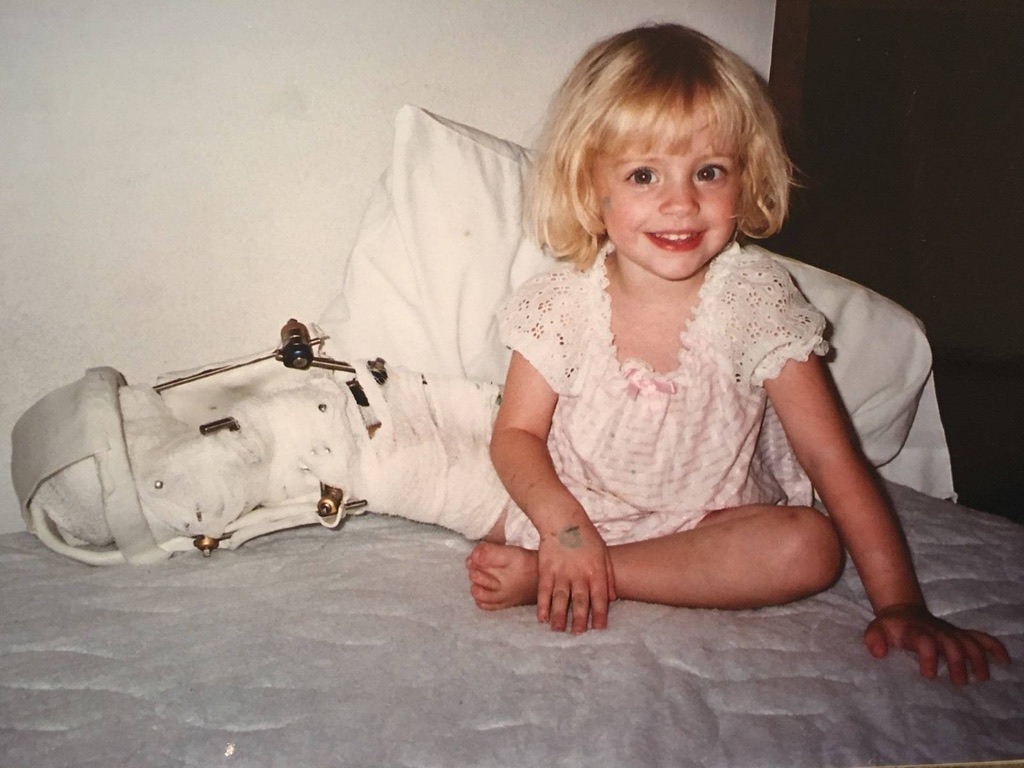
The pictures drift in and out of my memory—some sharp and vivid, others only a wisp—as I recall the accident that shaped my life before I was even two years old.
I remember my parents had a system of effectiveness built in to keep our young minds from wondering too far before it was time to play. “Go do ‘xyz’ and report back to me.”
No worries, because the likelihood they would tell you, “Thanks, now you may go and play” after a task was completed was very good. The system kept us checking in and on track, so they could be more present with us, and agreements would be fulfilled, aiding in household harmony.
When my father told me to go inside and report to my mother after I finished something, it made sense to me. I cannot recall entirely what I was doing, although I do remember heading inside and reaching to the upper portion of a bookshelf grasping for something out of my reach.
I need to check in with my mother… hmm… she’s busy washing everyone’s dirty feet in the sink. Maybe I should just report back to my father then?
Heading back, I slip onto the lawn outside our little home in Iowa. My father, who was driving the riding lawnmower, was in the process of reversing, not knowing his little girl had come back outside, and slipped right behind him…
The blades found me.
Panic erupted.
Much of what happened next is lost in my subconscious somewhere, only key details of the story etched into my mind available for recall.
My father’s blood-curdling cry summoned my mother, he clamped my leg with his hands, desperately trying to slow the bleeding.
Now on the hood of the car, my parents coursing with adrenaline “I’m just going to take a little nap…” I mutter. No, no no, my mother thought, keeping me talking so I didn’t loose consciousness. “I think I need a band-aid” I tell her “Oh sweetheart, you need a lot more than a band aid.” my mother replied, worry invoking her as they eagerly awaited the life flight on the way.
Time stilled, and eternity stretched.
The helicopter arrived. I still remember the fog on the breathing mask, the metallic smell of oxygen. Rolled aboard, I thought: I get to fly? Cool.
Eye’s getting heavy, my vision getting blurry… the door of the helicopter starts to close.
Beep beep beep I awake to the sound of a monitor next to me. Evidently, some time had passed. I’m engulfed in stuffed animals and strange smells and sounds unfamiliar to me. I lay in my hospital bed, leg elevated high above me. There are weird sticky yellow things attached to my chest. A sippy cup lays beside me, and a little card with 3 balloons and a teddy bear on the cover.
Many of the ensuing chapters live more in my parents’ memories than in mine. They’ve told me the details enough times that I can picture them, even if I didn’t experience them firsthand.
Back at the helicopter, my parents prayed the prayer no parent ever wants to pray: “You own her life. You gave her to us for a time. We hope that time is not over yet.”
The strangers in uniforms moved with calm efficiency around them, and every second stretched into an incomprehensible length. Taken into the helicopter, they said goodbye, never knowing if they would see me again, my life was in the hands of the Creator.
My six-year-old sister was told to grab her brothers and go pray. When she merely asked, “What room?” it was a small, oddly human reminder that structure can feel like a lifeline in moments of chaos.
My father stayed with my siblings, until someone was able to come attend to them. My mother climbed into the Sheriff’s back seat “No ma’am, that’s for the criminals, you ride up front with me.” They drove 120mph to meet me there, praying I’d make it against all odds.
Years later they found out, no one thought I’d make.it to the hospital before death gripped me, but my father’s hands—compressing, holding, refusing to let go—saved my life.
I learned later that the event was traumatic even for the paramedics involved, many of whom ended up taking a leave to recover for awhile after assisting in my rescue.
The neighbor watched my siblings, feeding them cereal for dinner. Lucky bastards. I’d have my own version of Special K later, ketamine was on the menu for me.
It was important for them to never leave me alone, they slept in the sorry excuse for a “visitor bed” — someone call Tempur-Pedic, because, from what I’ve heard, they desperately needed an upgrade.
My mother checked on my siblings at home, my older brother without skipping a beat asks “Is Kinsey dead?” gotta love a four-year-olds tact.
She plastered my hospital room with photos of me and my siblings so every doctor and nurse would see not just a patient, but a little girl named Kinsey.
And my parents prayed — and prayed, and prayed some more — singing “It Is Well with My Soul” as the many surgeries stretched across the next 26 days while they waited to find out what came next for me.
What could have ended me before I’d even begun became the first lesson in what it means to be anti-fragile. I didn’t come out of that accident weaker—I came out different, yes, but mentally stronger. And that strength has shaped every area of my life: my faith, my grit, my refusal to give up. The mower blades tried to write the end of my story. Instead, they sharpened the beginning.
And the grand irony? Mowing the law is now my favorite chore.
Funny how God works.


 The Flocking Farm
Leave a comment