
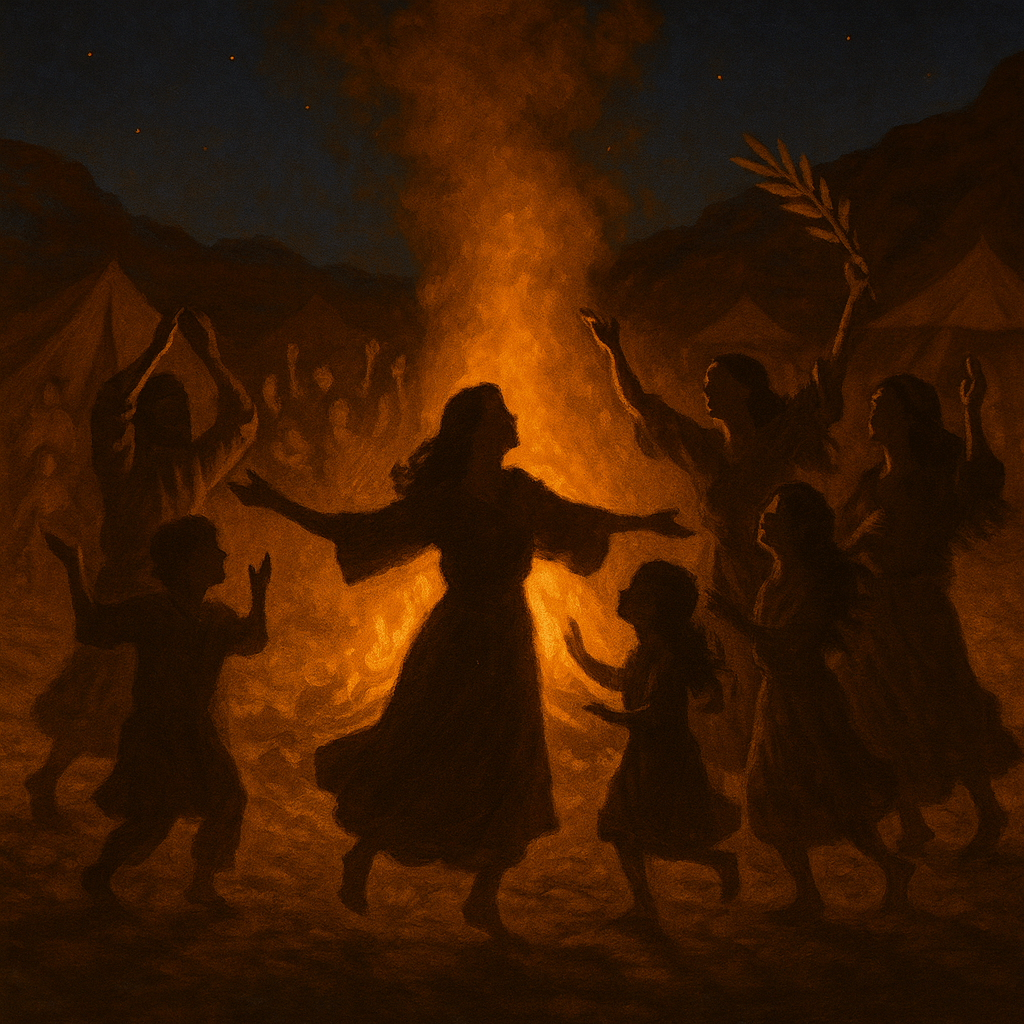
As the Fall Feasts approach—Yom Teruah (Feast of Trumpets), Yom Kippur (Day of Atonement), and Sukkot (Feast of Tabernacles)—many believers in Messiah find themselves asking: Why should we, as New Covenant followers, keep these ancient celebrations? Aren’t they just “Old Testament” rituals for Jews?
The answer is found in one simple verse:
“He that says he abides in him ought himself also so to walk, even as he walked.”– Yoḥanan Ri’shon (1 John) 2:6, Cepher
Did you know Yehusha (Jesus) celebrated Yahuah’s (The Lord’s) feasts? Yep!
He showed up year after year, weaving His life into the rhythm of God’s calendar. He taught in the Temple at Sukkot, He ate the Passover with His disciples, He even tied His identity to these appointed times.
And that’s where the excitement comes in: these Feasts aren’t dusty relics of an old covenant. They’re God’s parties. Appointments set on His calendar for His people—past, present, and future.
Think about it: the Creator of the universe penciled in time to feast, rejoice, repent, and rest with His children. Who wouldn’t want an invitation to that?
The Feasts aren’t about checking boxes or piling on religious pressure. They’re about discovering the joy of stepping into the same celebrations Yehusha (Jesus) Himself kept. They’re about tasting the delight of God’s rhythm, rehearsing redemption, and looking forward to the Kingdom to come.
If you’ve never thought about Jesus as a festival-goer, get ready. Once you see it, you can’t unsee it—and you may just find yourself wondering how you ever missed the invitation.
“But Didn’t He Fulfill the Feasts?”
You might be thinking: Yes, Jesus celebrated them, but since He fulfilled them, we don’t have to anymore, right?
Great question! And honestly, that’s where it gets even more exciting.
Here’s the thing: fulfillment doesn’t mean cancellation.
Think of it like a wedding. The engagement party doesn’t become meaningless once the wedding happens — it’s part of the whole love story. In the same way, the Feasts aren’t outdated “previews” that get tossed once Messiah shows up. They’re ongoing reminders and rehearsals of the bigger picture.
- The Spring Feasts (Passover, Unleavened Bread, Firstfruits, Shavuot) were fulfilled in Yehusha’s first coming. He was crucified as our Passover Lamb, buried during Unleavened Bread, raised on Firstfruits, and poured out the Spirit at Shavuot. Perfect alignment.
- The Fall Feasts are still pointing us forward. Trumpets (Yom Teruah) looks to His return with a shout and a shofar blast (1 Thessalonians 4:16). The Day of Atonement (Yom Kippur) foreshadows final judgment and cleansing. Tabernacles (Sukkot) points to the day when Yahuah Himself will dwell with His people forever (Revelation 21:3).
In other words: the Feasts are the prophetic calendar of redemption. If the first half landed right on time, why would we stop watching the second half?
So no — the Feasts aren’t cancelled. They’re alive, meaningful, and bursting with hope. When we keep them, we’re not trying to “earn” anything. We’re simply stepping into the rhythm of God’s story and saying: I want to be part of this rehearsal for the Kingdom.
Yehusha (Jesus) Observed the Feasts
Throughout the Besoroth (Gospels), we see Yehusha faithfully participating in the Feasts:
- Passover/Unleavened Bread (Pesach) – He didn’t just attend; He revealed its fullest meaning by becoming the Passover Lamb (Luke 22:15; John 19:14).
- Feast of Tabernacles (Sukkot) – “Now the Jews’ Feast of Tabernacles was at hand… Then went he also up unto the feast…” (John 7:2,10). Yehusha taught publicly in the Temple during Sukkot, even declaring Himself the source of Living Water on the last great day (John 7:37–38).
- Feast of Dedication (Hanukkah) – Though not commanded in Torah, Yehusha still went up to the Temple during this festival (John 10:22–23).
He did not dismiss or replace the Feasts. He filled them with deeper meaning, pointing to Himself as the fulfillment of Yahuah’s redemptive plan.
His Followers Continued After the Resurrection
Some argue that the Feasts ended with the resurrection. Yet the opposite is true:
- Acts 2 (Pentecost/Shavuot) – The Ruach Ha’Qodesh (Holy Sprit) was poured out on the Feast itself, not on a random day.
- Acts 18:21 – Paul speaks of needing to keep the upcoming Feast in Jerusalem.
- Acts 20:6,16 – References to Passover and Pentecost show that Paul ordered his travel around the Feasts.
- 1 Corinthians 5:7–8 – Paul directly tells Gentile believers: “Therefore let us keep the feast…”
Clearly, the early assembly didn’t view the Feasts as obsolete—they saw them as prophetic and Messiah-centered.
The Delight of the Feasts
The Feasts aren’t dry obligations; they are delightful invitations.
Yahuah (The Lord) calls them “appointed times” (moedim), and like any good Father, He sets these times so His children can come celebrate with Him. Think about it: the Creator of the universe set apart days on His calendar to feast, rejoice, repent, and rest with His people.
- Yom Teruah, The Feast of Trumpets: bursts in with the sound of shofars, stirring our hearts with anticipation.
- Yom Kippur, The Day of Atonement: humbles us with repentance, clearing the clutter of our souls.
- Sukkot, The Feast of Booths: explodes with joy, dwelling in temporary shelters, eating, laughing, and remembering that Yahuah (The Lord) tabernacles with us.
Psalm 119:14 captures this spirit: “I have rejoiced in the way of your testimonies, as much as in all riches.” His instructions are not heavy chains; they’re treasures. When we step into His rhythm, we discover joy that money cannot buy.
Scattered, Yet Gathered
Some Feasts, like Passover and Booths, were commanded to be observed in Jerusalem. And while we long for the day when all nations stream to Zion (Isaiah 2:2–3), for now, many of us are scattered across the earth.
Does that mean we’re left out? Not at all.
Just as Daniel prayed toward Jerusalem in exile (Daniel 6:10), we too set our hearts toward the place of His Name, even while celebrating in our own homes, communities, and congregations. We do the best we can with where we are, and Yahuah (The Lord) honors hearts that desire to keep His ways.
Every sukkah built in a backyard, every shofar blast in a field, every table set aside for a special meal is a testimony: We are His people, even in exile, waiting for the day He gathers us home.
A Call to Return
Walking as Yehusha (Jesus) walked is more than morality—it’s adopting His lifestyle of worship. The Feasts are not burdensome legalism; they are appointments with our Creator, celebrations of our Messiah, and prophetic previews of eternity.
This Fall, consider setting aside time to honor Yahuah’s moedim (appointed times). Light the shofar on Yom Teruah, fast in repentance on Yom Kippur, rejoice and dwell in temporary shelters during Sukkot.
Because when we keep the Feasts, we’re not just looking back at history. We’re looking forward to the Kingdom—and there’s nothing more delightful than rehearsing the joy we’ll share with Him forever.
Curious How to Celebrate?
If this is brand new to you, you might be wondering: Okay, but what does celebrating the Feasts actually look like today?
Don’t worry — it doesn’t have to be overwhelming. The Feasts were never meant to be a burden; they were designed to be a joy! Think meals shared with loved ones, prayers lifted to Yahuah (The Lord), moments of repentance, and lots of rejoicing.
✨ I’m in the middle of putting together a Free Feast Guide that pulls all the biblical references together for quick and easy access (so you don’t have to flip through a dozen pages to find what you need).
But in the meantime, here’s a simple starter list on the upcoming feasts to get you going:
- Yom Teruah (Feast of Trumpets): Blow a shofar, gather for a meal, read 1 Thessalonians 4:16–17 and Leviticus 23:23–25.
- Yom Kippur (Day of Atonement): Fast or set aside the day for prayer and repentance, read Leviticus 23:26–32 and Hebrews 9.
- Sukkot (Feast of Tabernacles): Build a sukkah (booth) in your backyard or set up a tent, eat meals outside, rejoice with family and friends, and read Leviticus 23:33–43 and John 7:37–38.
Wherever you are scattered, you can join in. Every prayer, every meal, every joyful song under the stars is a way of saying: “Here I am, Father. I want to be part of Your rhythm.”
Shalom! 🌿

 The Flocking Farm
Leave a comment