
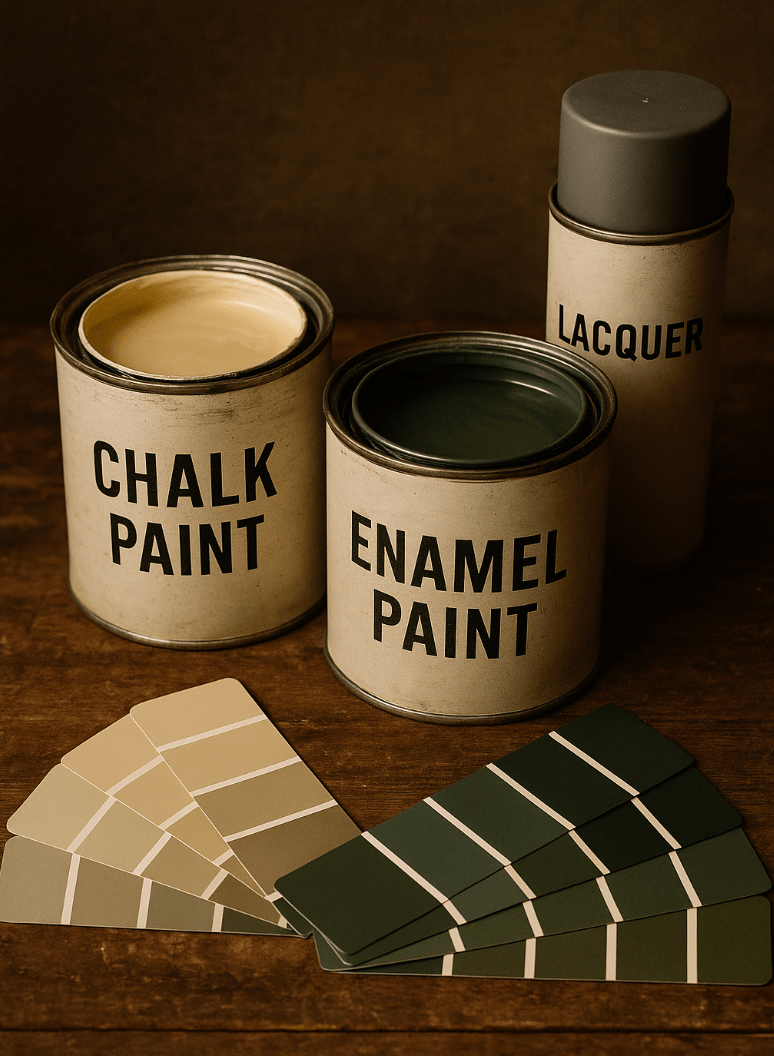
If you’ve ever stood in the paint aisle, questioning your entire existence while clutching a sample for a dresser you swear you’re going to flip, you’re not alone. Choosing the right paint for refinishing can feel like decoding ancient scrolls—but I’ve tested a lot, and here’s the truth:
There’s no one-size-fits-all winner.
It depends on what matters most to you:
- Do you want the most affordable option?
- Are you painting a piece that will take a beating (hello, toddler households), or will need to be shipped?
- Do you want something that cures quickly for quick turnover?
- Or do you want something foolproof you can slap on without sanding your fingerprints off first?
Let’s break it down.
❌ Why You Shouldn’t Use Wall Paint on Furniture
Let’s clear this up right now: just because it’s paint doesn’t mean it belongs on furniture.
Wall paint is designed for vertical surfaces that don’t get touched, bumped, or scrubbed on a daily basis. That dresser, side table, or vintage vanity? It’s going to be sat on, leaned against, wiped down, and lived on. Wall paint just isn’t built for that kind of action.
Even high-end wall paints can:
- Scuff or peel easily
- Feel gummy or soft under objects
- Get stained or watermarked over time
- Usually don’t go on very evenly
Scuff Defense is one of the few exceptions because it bridges the gap between wall and trim paint, but even then—it’s not your forever paint for heavy-use surfaces. You can do better.
🖌️ All-in-One Furniture Paints: Easy but Not Indestructible
If you’re new to refinishing and want a paint that’s:
- forgiving,
- low-prep,
- and actually kind of fun to use…
All-in-one mineral or chalk-style paints are your best friend. Brands like Melange ONE, Fusion, or Dixie Belle Silk have primer and topcoat baked right in, so you can skip half the prep (you should still clean thoroughly, and scuff sand your surfaces) and still get a gorgeous finish.
- ✅ Great for beginners
- ✅ Beautiful on detailed pieces
- ✅ Less overwhelming than enamel systems
- ✅ Dry very quickly
But here’s the tradeoff: they’re not as tough as enamel paints, and they’re rather expensive. If you’re painting a kitchen table, a kid’s dresser, or something you want to stand the test of time that’ll get daily use, consider sealing it with a water-based polyurethane—or leveling up to a urethane enamel instead.
🕰 What About Traditional Chalk Paint?
Before all-in-one formulas came onto the scene, classic chalk paint was the go-to for DIYers and vintage lovers alike. Think Annie Sloan, Dixie Belle, Rust-Oleum, or homemade recipes using Plaster of Paris.
Traditional chalk paint is:
- Ultra-matte and soft to the touch
- Great for layering, distressing, or rustic finishes
- Very forgiving on brush strokes and detail work
But here’s the catch: it absolutely needs a topcoat (or 2).
Unsealed chalk paint is porous, scuffs easily, and absorbs stains like a sponge. Most people seal it with:
- Wax (for a buttery, low-sheen feel—though it needs reapplying)
- Polyurethane or polycrylic (for more durability and wipeability)
🪵 When it shines: ornate pieces, heavily textured surfaces, or when you want that hand-finished, old-world feel.
⚠️ Not ideal for: high-traffic pieces or items that need regular cleaning—unless you’re sealing really well and are ready to maintain it.
💎 Lacquer: The Glossy Powerhouse for Pros
If you’re after that flawless, smooth-as-glass, spray-finish look you see on high-end pieces, lacquer is the holy grail.
It cures lightning fast, has incredible clarity and durability, and lays down like butter—when applied correctly.
⚠️ The catch? Lacquer is a hot finish, and not for the faint of heart.
- Must be sprayed
- Strong odor and flammable
- Steep learning curve
- Limited color range unless you’re tinting
- Lacquer is picky. It demands clean, compatible surfaces and proper barriers between layers.
If you’re a beginner, I wouldn’t start here—but if you’re scaling up your furniture business or looking for that finish, it’s worth exploring.
Popular options:
General Finishes High Performance Lacquer
Milesi or ILVA (European high-end lines)
Mohawk Pre-Catalyzed Lacquer
🏆 Best Overall: Enamel-Based Paints (Durable, Long-Lasting, Worth the Effort)
If you want a finish that lasts—something that can take a beating and still look polished—enamel-based paints are hands down the best choice for furniture.
These paints cure hard, resist scratches and moisture, and don’t need a separate topcoat. They do require a bit more prep work than beginner formulas, but the end result is worth every extra step.
🎯 My Go-To: Behr Urethane Alkyd Enamel
If you walked into my shop on any random day, chances are I’ve got a can of Behr Urethane Alkyd Enamel cracked open.
Why? Because it delivers pro-level results at a big-box price—with the color options of a candy store.
✅ Why I love it:
- Rock-hard durability – it cures into a tough finish that can handle real life
- Huge color selection – bold, moody, muted, vibrant—you name it, they’ve got it
- Levels beautifully – can be brushed, rolled, or sprayed with great results
- Easy to access – just walk into Home Depot, no need for special orders
- Better value by far—If you’re flipping furniture for profit or tackling larger projects, enamels are much less expensive per oz than all-in-one formulas.
⚠️ What to know before you start:
- Long cure time – it dries fast to the touch, but in needs about 2hrs between coats, and takes a few weeks to fully cure (this is especially important to note if you ship your pieces like I do).
- Requires proper prep – clean thoroughly, sand well, and prime surfaces
It’s not a quick fix, but for professional-looking results with gorgeous custom color options, Behr’s enamel is my first pick.
🧱 Other Heavy-Hitters in the Enamel World
If you’re looking for alternatives—or just curious what else the pros use—here are a few more solid enamel-based options:
- Sherwin-Williams Emerald Urethane Trim Enamel
Pro-level finish, excellent self-leveling, and great for cabinetry or high-traffic items. - Benjamin Moore Command
Commercial-grade durability and quick drying—ideal for high-use areas or short turnarounds. Harder to find, and works best when sprayed, but ideal for a rock hard finish with a much shorter cure time. - Valspar Cabinet & Furniture Enamel
Budget-conscious but still durable. A solid option if you want a hard finish without the high-end price tag.
All of these paints are:
- Built to stand up to wear
- Typically available in semi-gloss or satin
- Meant to be used with care (good prep = great results)
✨ Bonus: What Sheen Says About Durability
Let’s talk sheen. It’s more than just a style choice—it’s about how well your finish will hold up.
Here’s the basic rule:
The glossier the sheen, the more durable and wipeable the finish.
| Sheen | Durability | Best For | Notes |
|---|---|---|---|
| Matte / Flat | Low | Decorative pieces, distressed finishes | Beautiful but delicate—can stain or scuff easily |
| Satin / Eggshell | Moderate | Everyday furniture, dressers, nightstands | A nice balance between soft and sturdy (my preferred finish 💅🏻) |
| Semi-Gloss | High | Kitchens, kids’ furniture, dining tables | Very durable, easy to clean, reflects light |
| Gloss / High Gloss | Very High | Accent pieces, lacquered finishes | Showstopper, but prepped surfaces must be flawless |
Pro Tip: If you love a flat look but need more durability, use a matte poly topcoat to protect your piece without changing the sheen too much.
💭 Final Thoughts: Pick What Serves Your Piece (and Your Sanity)
There’s no single “best” paint for every project—but there is a best paint for your project.
If you’re just starting out, grab a quality all-in-one and enjoy the process.
If you want a long-lasting, professional result? Go with enamel, prep like you mean it, and let it cure.
If you’re ready to level up your spray game and want that ultra-sleek, showroom finish? Lacquer is a beast—but it’s beautiful once you learn how to handle it.
And if you’re like me? You’ll probably try a little bit of everything—and eventually find what fits your style best.
Furniture flipping isn’t just about the end result. It’s about the confidence you build along the way.
So prep well. Paint smart. And don’t be afraid to mess up a little—sandpaper is forgiving.
 The Flocking Farm
Leave a comment